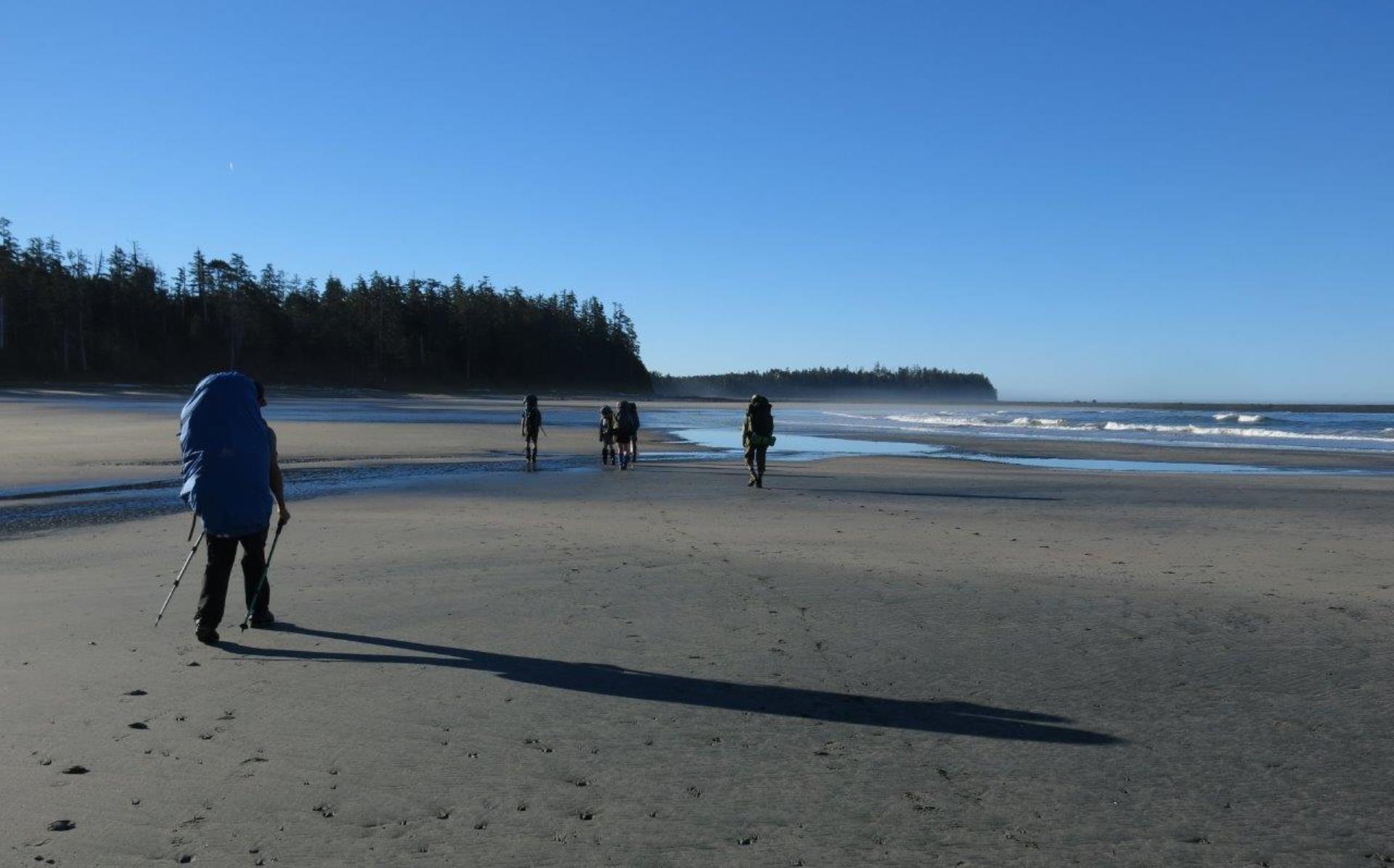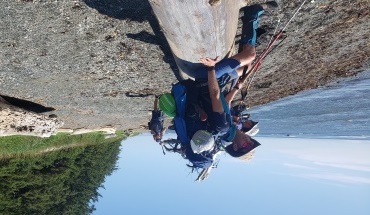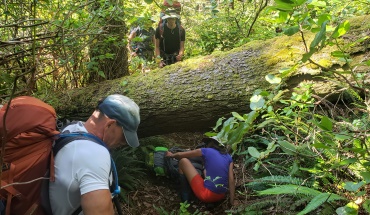
A very remote coastal hike with diverse beaches, very fewer hikers, an interesting history, and diverse wildlife. The Hesquiat Peninsula backpacking trip offers a wide variety of terrain and scenery, and is not for the faint of heart.
(†This price includes taxes and fees. Optional single supplements or equipment rentals may increase the price.)
$3130 + 3% booking fee + 5% Goods & Services Tax
This is a fly out and fly back trip. We will take a float plane from Gold River to our access point at Escalante Point, getting off in the surf. The Hesquiat Peninsula is a rugged coastal hike that spans 50 km along the western shore of Vancouver Island, British Columbia, between Nootka and Clayoquot Sounds. It is more rugged and remote than many of the other coastal hiking trails of Vancouver Island, and still has that open Pacific vista, providing access to viewing whales, wolves, black bear and more. This trail, if you can call it that, is as remote as you can get. Typically, less than 50 people a year walk these shores. We finish by the famous Cougar Annie's Garden at Hesquiat Lake, where our float plane will pick us up to return to Gold River.
West Coast Trail Dates for 2026 are now Parks confirmed.
May 18-26, 2026 - $2795 until Dec. 15, $2855 after 6 Spaces Available
May 30-June 7, 2026 - $2795 until Dec. 15, $2855 after 8 Spaces Available
June 14-22, 2026 - $2795 until Dec. 15, $2855 after 8 Spaces Available
June 28-July 6, 2026 - $2795 until Dec. 15, $2855 after 3 Space Available
July 14-22, 2026 - $2795 until Dec. 15, $2855 after 2 Spaces Available
July 28-August 5, 2026 - $2795 until Dec. 15, $2855 after 1 Space Available
August 12-20, 2026 - $2795 until Dec. 15, $2855 after 6 Spaces Available
August 26-September 3, 2026 - $2795 until Dec. 15, $2855 after 7 Spaces Available
Our sister company, Coastal Bliss Adventures also runs West Coast Trail Tours. Coastal Bliss Adventures West Coast Trail Dates for 2026
May 31-June 8, 2026 - $2795 until Dec. 15, $2855 after 8 Spaces Available
June 12-20, 2026 - $2795 until Dec. 15, $2855 after 8 Spaces Available
June 26-July 4, 2026 - $2795 until Dec. 15, $2855 after 2 Spaces Available
July 12-20, 2026 - $2795 until Dec. 15, $2855 after 1 Space Available
July 26-August 3, 2026 - $2795 until Dec. 15, $2855 after 8 Spaces Available
August 10-18, 2026 - $2795 until Dec. 15, $2855 after 8 Spaces Available
August 24-September 1, 2026 - $2795 until Dec. 15, $2855 after 8 Spaces Available
September 8-16, 2026 - $2795 until Dec. 15, $2855 after 6 Spaces Available
North Coast Trail 2026 Dates ("G" indicates guaranteed departure.)
We run scheduled North Coast Trail tours every other year (the next year will be 2027). We will run custom tours for four or more in 2026. Phone to inquire.
Cape Scott Explorer 2026 Dates ("G" indicates guaranteed departure.)
July 4-9, 2026 - $2,245 + 3% booking fee + 5% tax 8 spaces available
July 21-26, 2026 - $2,245 + 3% booking fee + 5% tax 8 spaces available
August 19-24, 2026 - $2,245 + 3% booking fee + 5% tax 8 spaces available
Nootka Island Trail 2026 Dates ("G" indicates guaranteed departure.)
June 18-23, 2026 - $3,180 + 3% booking fee + 5% tax 8 spaces available
July 15-20, 2026 - $3,180 + 3% booking fee + 5% tax 8 spaces available
August 19-24, 2026 - $3,180 + 3% booking fee + 5% tax 7 spaces available
South Chilcotins 2026 Dates
The South Chilcotin Mountain tour has been significantly changed over the last several years due to 3rd-party service changes and the Downton Lake fire of 2023. It is still a fantastic trip, a little more difficult than previously, more high country, but well worth the spectacular views and alpine environment. We offer two options: a fly-in/hike-out option and a hike-in/out option.
Fly-in: July 31-August 6, 2026 - $3697 + 3% booking fee + 5% tax 6 spaces available
Tombstone Mountains Hike 2026 Date Ranges ("G" indicates guaranteed departure.)
These are tentative dates. Yukon Parks only opens up the dates for booking access reservations to ALL hikers and companies in January 2026. We can't guarantee exact starting and ending dates until then.
July 27-August 3, 2026 Fly-in - $3,749 + 3% booking fee + 5% 3 spaces available
August 11-18, 2026 Fly-in - $3,749 + 3% booking fee + 5% 5 spaces available
August 23-30, 2026 Fly-in - $3,749 + 3% booking fee + 5% 6 spaces available
Tombstones Base Camp Fly-in/Fly-out 2026 *Dates
Not available for 2026, except as a custom tour only, with a minimum group size of 3 and a maximum of 4, and if logistically possible. $6499 + 3% booking fee + 5% tax
July 31-August 5, 2026 - $3130 + 3% booking fee + 5% tax 8 spaces available (Inquire about availability)
We will be running this tour in 2026, scheduled every other year. Plan your trip on this remote coastal hike for 2026 or 2028.
Due to political realities, this is now a Canada-only trip as the border crossing is closed. It is now a train-in/floatplane out trip. Check the itinerary for details.
Chilkoot Trail 2026 Dates - The following are dates for a CANADA ONLY Chilkoot trip.
July 8-14, 2026 - $3,699 +3% booking fee + 5% tax 6 Spaces Available
August 13-19, 2026 - $3,699 +3% booking fee + 5% tax 8 Spaces Available
Broken Group Islands 2026 Dates ("G" indicates guaranteed departure.)
(6 days) July 2-7, 2026 - $2,275 + 3% booking fee + 5% tax *8 spaces available
(4 days) July 2-5, 2026 - $1,754 + 3% booking fee + 5% tax *8 spaces available
(6 days) July 26-31, 2026 - $2,275 + 3% booking fee + 5% tax 8 spaces available
(4 days) July 26-29, 2026 - $1,754 + 3% booking fee + 5% tax 8 spaces available
(6 days) August 9-14, 2026 - $2,275 + 3% booking fee + 5% tax *8 spaces available
(4 days) August 9-12, 2026 - $1,754 + 3% booking fee + 5% tax *8 spaces available
(6 days) August 28-September 2, 2026 - $2,275 + 3% booking fee + 5% tax *8 spaces available
Turner Lakes Canoeing Tour 2025 Dates This Trip Is In The Middle Of The Permitting Process. We are awaiting the final word on the permit. ("G" indicates guaranteed departure.)
Yukon River Canoeing 2026 Dates ("G" indicates guaranteed departure.)
June 17-26, 2026 - $3380 + 3% booking fee + 5% tax
$3119 for 2-3 people booking directly by phone
$2769 for 4+ people booking directly by phone at +1-250-715-0034 10 spaces available
July 12-21, 2026 - $3380 + 3% booking fee + 5% tax
$3119 for 2-3 people booking directly by phone
$2769 for 4+ people booking directly by phone at +1-250-715-0034 10 spaces available
July 29-August 7, 2026 - $3380 + 3% booking fee + 5% tax
$3119 for 2-3 people booking directly by phone
$2769 for 4+ people booking directly by phone at +1-250-715-0034 10 spaces available
August 16-25, 2026 - $3380 + 3% booking fee + 5% tax
$3119 for 2-3 people booking directly by phone
$2769 for 4+ people booking directly by phone at +1-250-715-0034 10 spaces available
Teslin River Canoeing 2026 Dates
June 17-26, 2026 - $3199 + 3% booking fee + 5% tax
$2879 for 2-3 people booking directly by phone
$2559 for 4+ people booking phone at +1-250-715-0034 Contact us to enquire
July 29-August 7, 2026 - $3199 + 3% booking fee + 5% tax
$2879 for 2-3 people booking directly by phone
$2559 for 4+ people booking phone at +1-250-715-0034 Contact us to enquire
Day 0: Arrival in Nanaimo This denotes the day(s) spent on Vancouver Island before the listed start date of the trip. We like to have a pre-trip meeting the evening before this trip to go over gear and backpack weights, but may be accomplished through a call.
Day 1 – This morning we will pick you up from your accommodations in Nanaimo, drive to the west coast of Vancouver Island and the community of Gold River. After arrival in Gold River, we will fly by floatplane along Nootka Sound to close to Escalante Point, from where the trail heads down a beach to a small stream where we will spend our first camp. This stunning beach is worth spending time at, exploring the caves, coves, beaches and headlands. The beach at Escalante is one of the most stunning along the trail. We hike about 1.7 km to our campsite.
Today we time our journey so that we have a low enough tide to cross a tricky surge channel just north of Split Cape, 6km along the sandstone from camp. At the surge channel there is a cluster of spectacular sea stacks that are worth exploring, tides permitting. The surge channel is negotiated by either carefully climbing in and out of it, or by going around on the bushy ledge. This is the only real challenging feature along this trail. Once the surge channel has been crossed the hiking continues for another 1.5 km along more serrated sandstone or sandy paths at high water. Once we reach Split Cape there are sculpted conglomerate rocks to view. We continue for another 4.5 km along easy beach or sandstone to the beautiful beach and sand dunes at Barcester Bay, where we will make our camp for the night.
Our journey today begins along a flat sandy strip along the edge of the rock shelf. There is a black sand beach 4.5 km south of Barcester Bay, more interesting rock formations, sandstone domes and some larger stacks. This can be a great place to view eagles as they perch atop surveying the land and sea for prey. As we make our way around the point, we may catch sight or sound of sea lions. There is a good camping location here with excellent water. We will stop to fill up our water bottles before continuing on to Estevan Point. Water between this fill up point and our next camp is scarce, so be sure to drink up and fill up! We should be able to see Estevan Pt Light station from here. We will fill up with extra water and camp for the night about 1 km past the lighthouse, just in the forest, resting up for the next morning's boulder beaches.
Once around Estevan point and on the beach, hiking can be exposed if the weather is unfavourable. When we leave the lighthouse, we hike in the forest along the remains of an old telegraph line road that used to connect the lighthouse to Hesquiat village, but only to our camp. From there, we are on "billion boulder beach". If the tide is right, we will we able to walk out on the sandstone shelf and avoid the boulders, but will be tromping through water in our hiking boots. We will be able to camp at the Hesquiat village reserve (with permission). While at the village, we hope to be able to speak with Dianne Ignace, who lives on this reserve with some of her family.
Leaving the village, we cross Purdon Creek and head out to a mix of rocky beaches and sand beaches to the open beach highlight at Anton's Spit. We may pause here for lunch or to enjoy the day and the scenery. At the North end of this beach, we climb up the small rocky cliff and pass Le Claire Point's rocky headlands, after which we will find ourselves on a lovely pebble beach at km 40 to camp.
This is our final day. We will hike the final 5km to Boat Bay. This is along many pocket beaches and rocky headlands and some short, forested sections around some headlands when necessary. We respectfully journey through another First Nations reserve before arriving at Boat Basin. Once here and if possible, we will have a tour of Cougar Annie's Garden, by Peter Buckland, who renewed the garden and developed the property over his nearly 60 years of stewardship. Cougar Annie was an immigrant settler and pioneer who moved to Hesquiat in 1915: Ada Annie Rae-Arthur tamed a small part of these wild forests on her 5-acre homestead. Following this we will hike the short trail to the floatplane dock on Hesquiat Lake, where our pilot will pick us up and fly us back to Gold River. We will head into Gold River for lunch before driving back to Nanaimo to say good-bye and return to settled life.
inclusions and exclusions at a glance
Whats included in this tourItems that are covered in the cost of tour price.
Transportation from the point of origin and return
Air Nootka flights to and from the trail
Snacks/beverages on the expedition
All meals while on the backpacking portion
Meal preparation
Camping fees
Trail ferry fees
Exceptional guides for entire journey
Cooking gear/camp stoves/water filtration
Tents & tarps
Emergency radio/satellite phone/major first aid supplies
† We can provide sleeping bags, sleeping pads, and some other gear for rent. Click here for Gear Rental Options and pricing.
Whats not included in this tourItems that are NOT covered in the cost of tour price.
Transportation to point of origin, transfers, personal equipment, accommodation and food other than included in the itinerary.
Gratuities are not included. Our guides make every effort to ensure your holiday is all you expected and more. Recognition of a job well done is always appreciated; $10-20/day per guide is recommended.
Vancouver Many of the major North American carriers fly into Vancouver or alternately, Seattle. Check with your travel agent for options. There is a bus service, Quick Shuttle , from Seattle's airport to hotels in Vancouver. These run daily and are reasonably priced. For more information, in North America, phone 1/800/665-2122 or 1/604/940-4428 – Fax 1/604/940-4429. Check the link regarding shuttles and other airport information.
Nanaimo Several bigger carriers fly into Nanaimo, usually after a change in Vancouver. Check with your travel agent for options that take you all the way to Nanaimo. Alternatively, the Horseshoe Bay ferry in West Vancouver sails to Departure Bay, Nanaimo. The Tsawwassen ferry terminal also has sailings to the Duke Point ferry terminal in Nanaimo.
Places to stay and other details
Nanaimo The following hotels are recommended accommodations and are pick up locations. Naniamo Pick up & Hotels
Pick up: Departure Bay, Duke Point Ferry Terminal, or the following Accommodations:
Days Inn Harbour View Nanaimo
Address: 809 Island Hwy South, Nanaimo, British Columbia, Canada, V9R 5K1
Phone (250) 754-8171
Website: www.nanaimohotel.com
Best Western Dorchester Hotel
Address: 70 Church, Nanaimo, British Columbia, Canada, V9R 5H4
Phone: (250) 754-6835
Website: www.dorchesternanaimo.com
Painted Turtle Guesthouse
Address: 121 Bastion Street, Nanaimo, British Columbia CANADA, V9R 3A2
Toll Free: 1-866-309-4432
Phone: (250) 753-4432
This is a rugged hike for some portions. The best boots for this kind of backpacking are solid-able to take rough talus slopes, water proof, and with a full, stiff shank for ankle support. If you get new boots, it is important to break them in before your trip to ensure that they are comfortable and to minimize the risk of blisters. It is also a good idea to bring a pair of comfortable sandals or water shoes for wearing around camp and for crossing streams or other bodies of water.
For a multiday backpacking trip in varied terrain, you will want a backpack with a capacity of at least 65-85 liters, depending on the size of your gear and the type of trip you are taking.
Some key features to look for in a backpack for this type of trip include: Comfort: Look for a backpack with a comfortable and well-padded hip belt and shoulder straps, as well as a good ventilation system to prevent your back from getting too hot and sweaty. Durability: Choose a backpack made from strong and durable materials, such as ripstop nylon, to withstand the rigors of the trail. Weather resistance: Consider a backpack with a waterproof or water-resistant cover or built-in rain cover to protect your gear from the elements. Load-carrying ability: Look for a backpack with a sturdy frame and good load-carrying capacity to support the weight of your gear. Organization: Choose a backpack with plenty of pockets, compartments, and attachment points to help you keep your gear organized and easily accessible. Size: Make sure the backpack fits you well and is the right size for your body and your gear.
It is also a good idea to try on a few different backpacks and load them with weight to get a feel for how they carry before making your final decision.
Hiking poles can be a helpful tool for a rugged backpacking trip, as they can provide additional support and stability on rough or uneven terrain. They can also help to reduce the impact on your joints and muscles by distributing some of the load to your upper body.
However, whether or not to use hiking poles is ultimately a personal decision, and it may depend on factors such as your physical abilities, the terrain you will be hiking on, and your personal preference. Some people find that hiking poles help them to maintain balance and reduce fatigue, while others prefer to hike without them.
If you do decide to use hiking poles, it is important to choose a pair that is comfortable, lightweight, and adjustable to your height. It is also a good idea to practice using them before your trip to get a feel for how they work and to ensure that you are using them correctly.
You can expect to carry up to 40 lbs, depending on the gear you bring. (about 18.2 kg)
We pack and prepare the food to bring, usually about 7 to 8 lbs (3.1 to 3.6 kg). We also share out the group gear. We are also supplying the tents, which typically weight 4 to 6 lbs., depending on whether they are double or single tents (double occupancy is standard, singles require a supplemental charge). Double tents are split between guests, so usually contribute about 3 lbs. to pack weight.
Altogether, expect to be given about 11 to 13 lbs. (5.0 to 5.9 kg). If you want your pack weight to be 35 lbs. (15.9 kg) or less, then your 60+ litre backpack and gear that you bring, along with 2 Litres of water, can only weigh up to about 22 lbs. (10 kg).
Nootka Island is relatively flat, level ground, so it is only moderately strenuous. You still need to train, and we do not supply sherpas. Although the hiking is fairly simple, you are still carrying everything needed for the entire trip.
Tips, or gratuities, are not mandatory. However, please consider what service is actually being given to you. While you might think that the company should just pay the guides better, it is not so simple. We do work in a competitive market, and pay rates are a function of the trip prices. If we could double prices, we would pay guides significantly better. At Sea to Sky, we have some of the better pay rates in the industry, and we are always pushing our competitors to increase pay rates for guides, but there is only so much we can do. Guides are seasonal workers. They shift off of their summer season to winter activities, or fill in with retail work, which is usually little more than minimum wage, often to periods of no work between seasonal jobs. It is a hard job, and wearing on the body.
The guides carry most of the group gear, so they have heavier loads than you have, all for you, because they would not be carrying much of the extras on a personal trip. Your guides are teaching you, helping you through challenges, cooking for you and serving you your meals, providing a safety envelope for you, and if you have a really good guide, they are filling you up with a deeper experience of being in the place you are visiting by telling you about the flora, fauna and history of the place.
So, how much should you tip your guides?
If you ate every meal out in a day, at a good, but low-cost restaurant, you would probably tip between $10 and $15 per day. If you were travelling and visiting a city and ate all your meals out, this is about how much you would tip for the day, low end. I would submit that the guides are feeding you all three meals in a day, AND serving you in so many more ways. That makes $10-$15 a day a minimum consideration, really. 10% to 15% of a trip price has been another rule of thumb that has been used. If your trip price is $2000, then $200 to $300 split between the guides is reasonable, and falls within that standard. Like most humans, guides are motivated when they are recognized and valued.
Your circumstances matter. If you are a student and clearly struggled to put together the cost of the trip, or have other circumstances that limit your ability to tip, guides understand and honour your appreciation, no matter what the size. However, if you have a large income or high net worth and means, a small tip might be a slap in the face. If you have means and you clearly and vocally appreciated the guides and all they did, and then leave a $50 tip after a 7 to 9 day trip, that amount would probably be insulting. If you have a fairly large income or net worth, you likely spend it on higher end restaurants, and maybe higher cost wine, drinks or desserts. You might even give a $50 tip for a dinner meal out-for ONE meal, so just consider your ability to tip and the level of service you received over the whole trip.
The largest tip any of our guides has received from one person is $1,500.00 for a 9-day trip. This was highly unusual, and was because we went way out of the way to replace her boots in the middle of the trail because her boots were falling apart, and was on top of paying for the boots and the transport out to the trail. That was extraordinary service, and an extraordinary tip. On average, guides usually receive about $75 to $125 from each guest for each guide.
At Sea to Sky, we also split the tips between the lead and assistant guides, and proportionally with any drivers. We have a strong culture of teamwork and both the lead and assistant guides play essential roles for you, so we ensure both share equally in the tips for the trip. Tips are not shared or taken by owners and managers not on your trip, unless you send it separately and specify it is for service before or after a trip.
What should I wear? What clothes are suitable?
For any wilderness adventure, "layering" is one of the most critical concepts. Layering clothing can have several advantages:
Temperature regulation: Layering allows you to adjust your level of warmth by adding or removing layers as needed. This can be especially useful in unpredictable weather or in environments with fluctuating temperatures. Comfort: Layering can help you stay comfortable in a range of temperatures and activities. For example, if you're going for a hike, you can wear a base layer to wick sweat away from your skin, a mid layer for insulation, and a outer layer to protect against wind and rain. Versatility: Layering allows you to mix and match different pieces of clothing to create different looks and adapt to different situations. Style: Layering can add depth and interest to your outfit, allowing you to express your personal style and create a polished look. Protection: Layering can also provide protection against the elements, such as wind, rain, and cold temperatures.
For any wilderness adventure, "layering" is one of the most critical concepts.
Layering clothing can have several advantages:
Temperature regulation: Layering allows you to adjust your level of warmth by adding or removing layers as needed. This can be especially useful in unpredictable weather or in environments with fluctuating temperatures.
Comfort: Layering can help you stay comfortable in a range of temperatures and activities. For example, if you're going for a hike, you can wear a base layer to wick sweat away from your skin, a mid layer for insulation, and a outer layer to protect against wind and rain.
Versatility: Layering allows you to mix and match different pieces of clothing to create different looks and adapt to different situations.
Style: Layering can add depth and interest to your outfit, allowing you to express your personal style and create a polished look.
Protection: Layering can also provide protection against the elements, such as wind, rain, and cold temperatures.